
Q&A with Steel Cartwheel
Steel Cartwheel is a new project by Seattle musician Alex Sokoll. After retiring his previous artist name, A.M. Sokoll, at the end of 2024, he spent 2025 crafting a sound that balances the abrasiveness of industrial rock and the rhythms and beats of EDM. The result is Steel Cartwheel, which, in very local musician fashion, was the name Alex decided while at SIFF Uptown waiting for the Jeff Buckley documentary to begin.
After attending countless shows and open mics across Seattle, Alex hopes to leave his own mark on a music scene that he deeply cares for. He also aims to get people to bob their head, move their feet, make a stank face, or all of the above.

Two years ago you retired your previous project, A.M. Sokoll, and created this new project, Steel Cartwheel. Can you tell us a bit more about the decision behind that?
There were many reasons, but the main one is the A.M. Sokoll songs were so attached to my personal struggles that I didn’t enjoy sharing or attaching a brand to them. My default was to write about really painful events, which was therapeutic, but the time would come to share them and I recognized how uncomfortable and vulnerable it felt. That made playing them difficult, and I especially hated promoting them. It culminated in a breakdown and scrapping everything.
Shelving the project gave me the chance to work on my mental health (an ongoing effort) and repair my relationship to music, performing, songwriting, etc. Steel Cartwheel has already been the most fun I’ve ever had with music, but I will always be grateful for what I learned in the A.M. Sokoll days.

Where does the name Steel Cartwheel come from?
My goal in figuring out a new name was finding something that balanced the heaviness of the music and the playfulness I approached it with. I wanted something on brand that stuck with you, and spent months figuring out what that was. Then it came to me - Steel Cartwheel. I thought of it while at SIFF Uptown waiting for the Jeff Buckley documentary to start (decent doc - live footage is ELITE). I had just seen LCD Soundsystem the previous weekend, and immediately after the doc I saw Nine Inch Nails. The name Steel Cartwheel was kind of my “picking a word representing each band” and mashing them together. I like to think my song “Cherries” is like if Nine Inch Nails made an LCD Soundsystem song.
Besides the name change, the sound that you’ve created with these two projects is quite different. What led you to such a sonic shift?
Simply put, I learned what I like to make and had the courage to make it. I didn’t start learning music until after college, so in the early days I felt I had to “catch up” to an elite music scene. I put myself out there long before I figured out my musical identity. Because of that, A.M. Sokoll was built partly with others’ taste in mind (which is dumb - don’t do that), but I tried to balance that with my own taste and the lack of committing to a side meant the sound didn’t quite work. Steel Cartwheel is me fully leaning into my own taste, and also comes from being patient with my musical journey. In beautiful irony, the moment I stopped vying for validation from others is when I started getting it the most. A lesson in being yourself!
Your new EP, Hating Is Obliterating, is actually cut down from a longer concept album. Do you have any plans to release those songs that were cut in the future?
I’m not opposed to it, but some of them are interludes pertaining to the original story and I can’t imagine those would be kept. One is still in my active setlist, and there are a few I still really like. Once the EP drops I’ll have a clearer plate to revisit them.
Any plans for a physical version of the EP?
Not currently, but if enough people want it I’m open to going that route.

You also recently had an EP release show at Conor Byrne. What can you tell us about it?
Oh my god. I can undoubtedly say it was the best night of my music life. So many people were there to support. Musicians who’ve been doing this long enough know that you can put your heart and soul into promoting a show, and for many reasons it can undersell. This did not - especially for a weekday show. Not only that, but The Noble Manes and YUELAN who were also on the bill absolutely killed it. The music throughout the night was so diverse - but the energy was palpable from the very start of YUELAN's set to the very end of mine. And of course, it was so special having it at Conor Byrne, which has been like a second home to me since 2021. So grateful to everyone who made that night possible.
You mentioned that the show was your only planned one with a full band and that going forward you're looking to perform solo. What made you decide to have a backing band for this show?
I felt the occasion called for one. Solo will be easier for me to have complete control over the sound, but I can’t deny the energy of a live band - especially with two other bands on the bill. Plus, it was a chance for some of my longest friends and closest supporters in the scene to have been in the band and play with me, which was also really special because it was the first time I got to play a full set with all of them. They’re all so talented and I appreciate the time they carved out to be part of such a special night.

On Instagram, you described the show as a resolution to your previous project. Can you speak a bit more about that?
The last band show I had played was in February 2024 at Conor Byrne for releasing Part 1 of a double album I released under my previous name. The reception was good, and in the moment I felt good, but those creeping feelings of that material not being something I wanted to hitch my wagon to were starting to form. By the time Part 2 was ready to drop, I had a bit of a breakdown and scrapped everything, including the release show for it. The planned Part 2 show had The Noble Manes and YUELAN on the bill, so in planning for this, I knew I wanted them back. Somehow, both were available, and with it being back at the Byrne, playing with a band, and with them involved, I felt I finished what I started and officially closed that chapter so I can move forward with this one.
You have a "Hating Is Obliterating" flag. Which came first, the flag or the EP name?
EP Name! I don’t even remember how the flag idea came to be, but I think it perfectly represents the urgency of the message.
What is your creative process like?
My creative process can vary greatly depending on the day and my mood. Certain songs start with lyrics; others start with melody or rhythm. I would say most of what I've written for Steel Cartwheel has been the latter, but sometimes I'll have a set of lyrics and an instrumental that exist separately and I find a way to fuse them, which is very satisfying.
Do you have a favorite song that you've written?
Honestly no. All five songs on the EP have something about them I love equally. "Cherries" and "I Know Too Much" each have strong thematic foundations, but "Wait a Minute" is unabashed catharsis, "Sleepwalking" is currently the most fun to play, and the grooves and dynamics on "Boil" make it the perfect closer.
Thus far, you’ve created a very consistent color scheme with black and red. What was the decision behind that?
Originally it was just matching the colors of my keytar (which I can’t believe I’m only mentioning now. HUGE influence on the new sound and direction), but much of it also relates to the material of the EP, particularly “Cherries” and “Wait a Minute”.
At the time I was writing what was originally a larger concept album, I was reading They Thought They Were Free, written by an American journalist working in Germany post World War 2 in the early 50s. He described the environment of the country and locals views Hitler and Nazism based on interviews, and while the book has received rightful critique in its construction, he describes the initial success of nazism in a way that draws uncanny parallels to how Trump has built his political following (attacking education, deflecting criticism, creating division among the populous, etc.)
The red and black emphasis has become my way of taking a color scheme attached to hatred and turning it on its head. I don’t know if I’ll keep it going after this first era, but it’s nice I found a way to couple the visual brand with the EP material.
In many ways, Steel Cartwheel seems to be almost a concept project as a whole, with a very intentional story and worldbuilding. Where do you see it going from here?
It certainly could be interpreted that way. I haven’t given that level of it much thought. In the short term I just want to keep writing and see where it takes me. More than anything I’m focused on shoring up my live set up so I can play more shows. The EP is really just a place to refer people if they hear me out and about. The live music element is what I really want to hone in on next, and from there we’ll see how it shapes the rest of the project.
Are there any other elements you'd like to add in the future to further that storytelling? Like music videos or concept art? I could see a vision similar to what the Gorillaz did with Plastic Beach (in particular) working well.
LOVE me some Gorillaz and Plastic Beach. That visual component would be so sick. I thought about that a little bit with the EP but it was too financially daunting between existing production and branding costs. Maybe if I were to attach it to a single it would be more achievable. I’m currently in a bit of a “pick and choose” phase of my artistry, but getting to a point where I can do stuff like that is a solid goal.
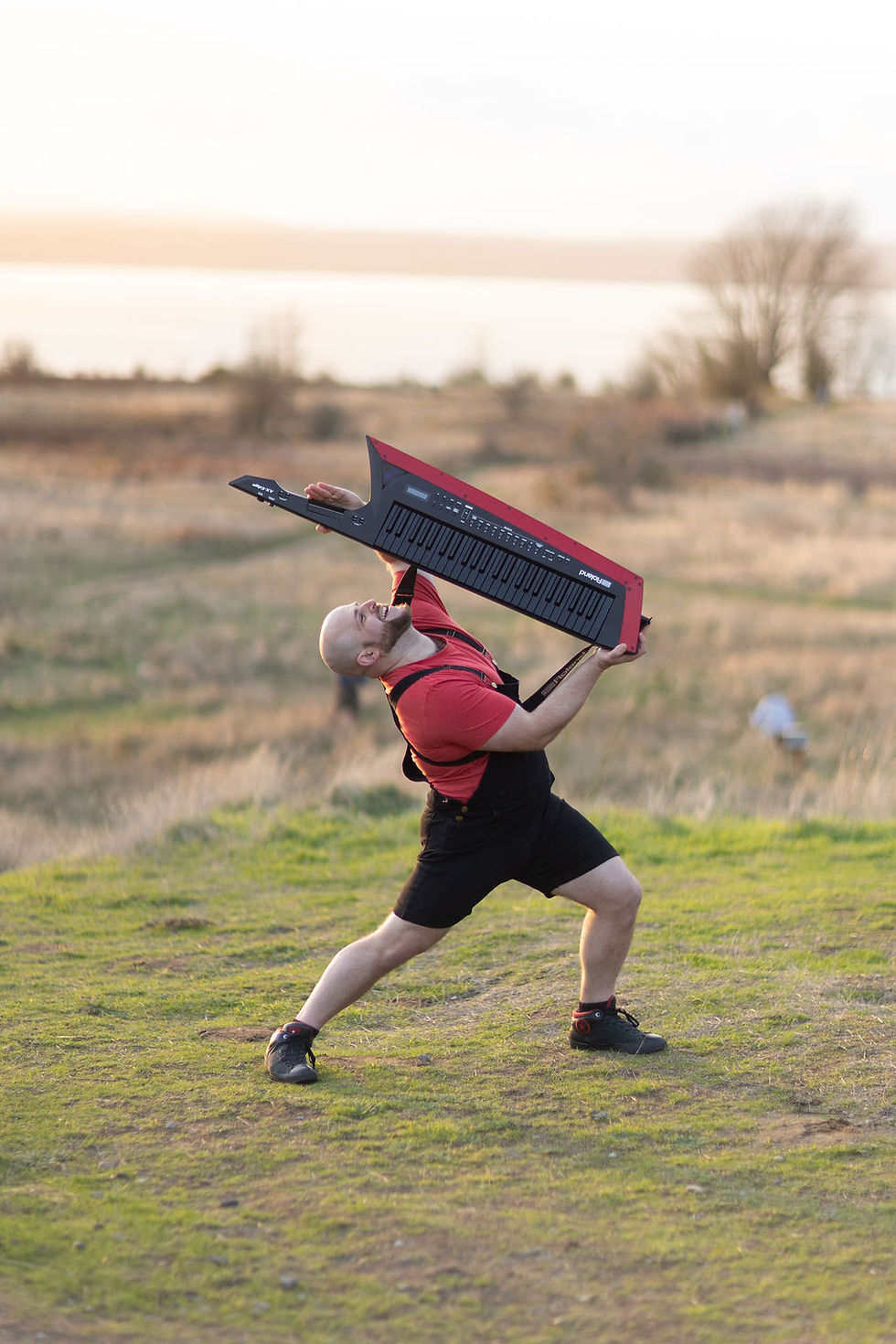
As you mentioned, you play the keytar, which is a more unique instrument. How did you first become interested in it?
It started as primarily a functionality thing. I found it difficult to play keyboard and sing into a microphone at the same time (leaning over just felt awkward and I’m not a big fan of sitting to play). I just wanted something that gave me a bit more flexibility. Then I actually had it in my hands and was just blown away at everything it can do. I still discover new uses and sounds all these years later (I just learned about a pitch bend feature from YUELAN, who plays the same model I do, at the EP release show - it’s an endless well of usage).
Throughout this interview, we’ve spoken a lot about how intrinsic the concept of contrast is to this project. Every aspect of it--from the name and the creation of the music to the differences between the themes of the lyrics and the playfulness of the imagery in your cover art--highlights a balance between lightness and heaviness. What drew you to that idea specifically?
The contrast was a thought experiment more than anything. I used to run into the mental roadblock of “tone and lyrics need to align”, but considering some of my favorite artists and albums I’m not sure why. A good example is the album In a Poem Unlimited by U.S. Girls - one of my favorites in the last decade. Some of that lyrical content is super heavy, but much of the album is performed with a jazz-funk ensemble that gives it an infectious groove. Some of the tones definitely lean into the vibe of the lyrics, but a lot of them act independent from that vibe. I just think I listened to enough albums like that to where I finally said “maybe I can do this too” - and it opened the sonic door much wider.
How did you work to weave that contrast throughout?
Some of it happened naturally through my stylistic preferences (I prefer writing in minor keys instead of major, for example) and some are just rooted in the plans for the original release. I wrote that album with the intention of keeping listeners engaged through dynamic variety, so what you hear for the most part are the livelier songs from the album but there are some that are more chill. Along the way, just reminding myself to keep it fun was also helpful. These are serious topics about our current state of affairs but it doesn’t mean everything has to be doom and gloom about it. In fact I’d argue it shouldn’t.
If you could have any of your songs featured in a piece of media, which song would it be and what would you like it to be featured in?
Oooh this is a killer question. I think "Sleepwalking" is probably the most cinematic track I have. I can envision the ending solo soundtracking a big battle scene in some 80s movie. "Wait a Minute"'s instrumental would go hard in a Mad Max movie too.

If you could pick any band or artist, past or present, to tour with, who would it be and why?
St. Vincent. Her ability to reinvent herself between albums and continue to produce at the level she does is remarkable. Daddy's Home and All Born Screaming go very hard in very different ways.
Honorable mentions to Bjork and U.S. Girls.
Who, or what, has most influenced your music and artistic style?
Being from close to Detroit but moving to Seattle in my early 20s greatly influenced my style. There was a lot of rock and Motown growing up, and I like 70s Motown in particular which was grittier and more about modern and darker topics.
Then I came to Seattle and was entrenched in the club scene. I had many late nights at places like Kremwerk, The Underground, Monkey Loft, and others, and this spiked my love for dance music. I love that balance of heaviness and fluidity.
What are you listening to currently?
I often find myself listening to a lot of different things, and it can range from local Seattle bands to the big names (I've been in a pool of 2010's nostalgia with Katy Perry recently). I'm really looking forward to the new James Blake album, and I love the records from Geese and Maruja last year.
There's also an Instagram account called @indiecharliebrown that takes songs and overlays them on Peanuts cartoon clips, and I found at least three songs through there that I can't stop listening to. Charlie Brown stays undefeated.
Listen to Steel Cartwheel's EP 'Hating Is Obliterating' now.


Comments